🖼️ View Full Resolution
✨ Constellation: Cygnus
🚀 Distance: 3,300-4,000 Light Years
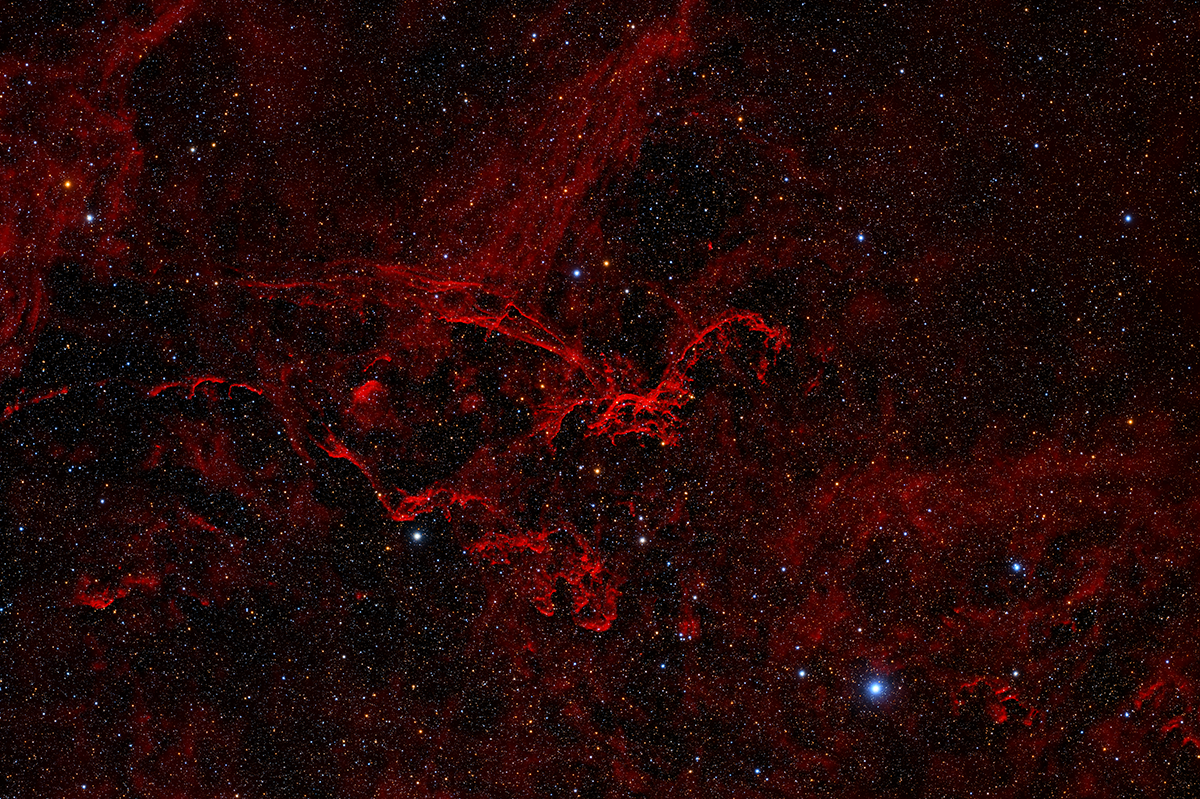
Commonly known as the Flying Dragon Nebula, Sh2-114 is an incredibly faint and complex emission nebula located in the constellation Cygnus, roughly 3,300 to 4,000 light-years away. It was first cataloged by American astronomer Stewart Sharpless in his second edition of the Sharpless Catalog published in 1959, based on the Palomar Sky Survey plates. Unlike traditional HII regions that appear as spherical clouds, Sh2-114 is defined by its unusual filamentary structure, consisting of thin, sweeping arcs of ionized gas that resemble a dragon with outstretched wings. These "veins" are thought to be the result of intense stellar winds from massive, hot O-type stars interacting with the complex magnetic fields and turbulent gases of the interstellar medium. The nebula is notorious among astrophotographers for its extreme faintness; it emits almost exclusively in the Hydrogen-alpha line, requiring significant integration time to pull its delicate, dragon-like "scales" from the background noise.
🔭 Equipment: Antlia 3nm Narrowband Hydrogen Alpha Pro Filter 2″, Optolong LRGB Filter Kit 2″, iOptron CEM60 Center Balanced Equatorial Mount, iOptron Permanent Pier, MeLE Fanless Mini PC Quieter3C, Pegasus Astro Pocket Powerbox Advanced G2, Primalucelab Alto-1 Telescope Motor Cover, Primalucelab Giotto 120 Smart Flat Field Generator, William Optics FLAT 6AIII (0.8x Reducer), William Optics Fluorostar 91, ZWO ASI224MC One-Shot Color USB3 Planetary/Guiding Camera, ZWO ASI2600MM Pro Monochrome Cooled Astronomy Camera, ZWO EFW (Electronic Filter Wheel) 7 x 2″, ZWO f/5 30mm Mini Guide Scope
📅 Session: October 7-8, 10-11, 15-19, 2024
📸 Exposure: Ha frames 256 * 300s
RGB frames 75 * 180s
Calibration Frames: 30 Flats, 30 Darks, 100 Bias
Total Integration Time: 25 hours
💻 Software: Nighttime Imaging ‘N’ Astronomy, PHD2 Guiding, Pixinsight