
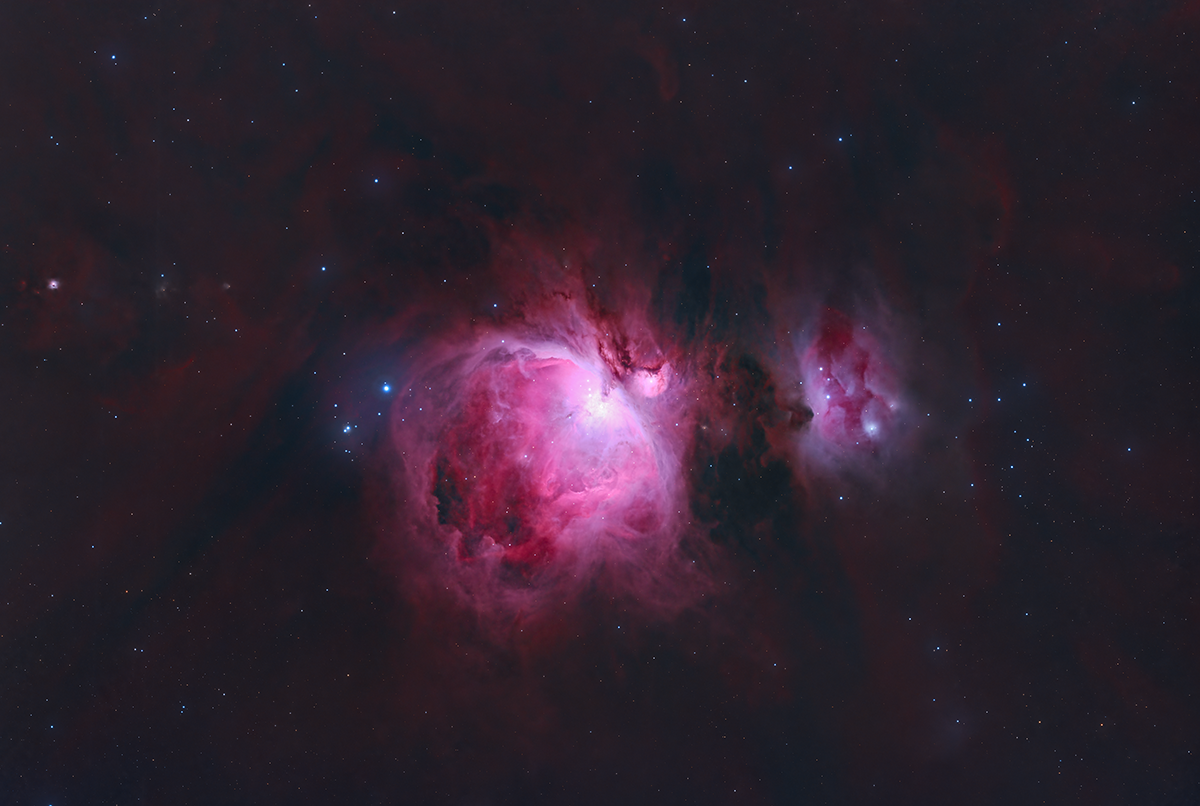
✨ Constellation: Orion
🚀 Distance: 1344 Light Years
🔭 Equipment: iOptron CEM60 Center Balanced Equatorial Mount, iOptron Permanent Pier, MeLE Fanless Mini PC Quieter3C, Pegasus Astro Pocket Powerbox Advanced G2, Primalucelab Alto-1 Telescope Motor Cover, Primalucelab Giotto 120 Smart Flat Field Generator, William Optics FLAT 6AIII (0.8x Reducer), William Optics Fluorostar 91, ZWO ASI224MC One-Shot Color USB3 Planetary/Guiding Camera, ZWO EAF Electronic Focusing Motor, ZWO f/5 30mm Mini Guide Scope, Optolong LRGB Filter Kit 2″, Antlia 3nm Narrowband Hydrogen Alpha Pro Filter 2″, ZWO EFW (Electronic Filter Wheel) 7 x 2″
📅 Session: December 19 & 29, 2023
📸 Exposure: 10, 30, 60s BIN2 RGB Masters (R-1900s, G-1900s, B-1900s) = 5700s 30, 60s BIN1 Luminance - 1740s 180, 300s BIN1 Ha - 6600s Total: 3.9 Hrs
💻 Software: Nighttime Imaging ‘N’ Astronomy, PHD2 Guiding, Pixinsight
After 2 years of uncertainty on using these images with different exposures and BIN settings, I returned to Pixinsight after I originally integrated the light frames to separate master images based on exposure times in 2023. My primary goal was to tame the bright core enough to allow the inner stars known as the Trapezium to be visible, utilizing the new processes available in 2025 such as the recent Multiscale Gradient Correction and Multiscale Adaptive Stretch.
Starting with the color masters, I used Channel Combination to create the RGB masters for 10s, 30s, and 60s. After creating RGB masters, I used Star Alignment to realign the stars on the separate RGB masters with the 60s master as the reference image. I repeated the process for the Luminance using the 300s master and the Hydrogen Alpha's 600s master. I then performed gradient extraction on all 7 aligned master files using Spectrometric Flux Calibration, followed by Multiscale Gradient Correction. Next, I used HDR Composition to merge the 10, 30, and 60-second RGB masters into a single HDR master file. I repeated this with the Luminance and Ha masters to have 3 final HDR master files. I corrected the eccentricity of the stars using BlurXterminator in Correct Only mode, followed up with color correction of the HDR_RGB image using SPCC. On all 3 HDR masters, I ran a linear noise reduction with NoiseXterminator with denoise at 0.50 and detail at 0.30. for all 3 masters. StarXterminator was used next to generate a stars-only image from the RGB master to save later, and stars were completely removed from the luminance and narrowband masters.
Multiscale Adaptive Stretch was used to perform a stretch to non-linear on all masters. For the luminance: Aggressiveness = 0.85; Target Background = 0.110; Dynamic Range Compression = 0.30; Contrast Recovery = true; Scale Separation = 1024. RGB: Aggressiveness = 0.80; Target Background = 0.120; Dynamic Range Compression = 0.45; Contrast Recovery = true; Scale Separation = 1024; Contrast Recovery Intensity = 1.000; Saturation Enabled = true; Saturation Amount = 0.85; Saturation Boost = 0.60. For Hydrogen Alpha: Aggressiveness = 0.75; Target Background = 0.109; Dynamic Range Compression = 0.30; Contrast Recovery = true; Scale Separation = 128; Contrast Recovery Intensity = 1.000. A non-linear noise reduction was followed using NoiseXterminator with settings of denoise = 0.90; detail = 0.15 on all masters.
Once stretching was complete on all starless masters, I performed the following work on each master; for the HDR luminance master a second run of NoiseXterminator with denoise: 0.90 and detail: 0.15 was done. Contrast was increased to bring out more nebulous detail with 2 runs of Local Histogram Equalization (LHE), radius = 40; Contrast Limit = 1.5; Amount = 0.350, and a second run with radius: 60, Contrast Limit: 1.5, Amount: 0.600. For the HDR_Ha master, I repeated the second noise reduction, but with only 1 run of LHE with radius: 125, Contrast Limit: 1.5, and Amount: 0.600. Lastly the HDR_RGB image, noise reduction was done, but followed by Curves Transformation to use slightly boost the vibrance with the Chroma (CIE *c) component and a small increase of color saturation.
Bringing it all Together
The starless HDR images were moved into ImageBlend to add the HDR_Hydrogen Alpha as the blend image to the HDR_RGB base image. The Filter Type was set to Color, choosing Red, the mode was set to screen, and I reduced the opacity to 0.50. Slight adjustments to the Blackpoint, increasing to 0.057, Highlights down to 0.9, and Midtones down to 0.328, creating a new ImageBlend image. With the new ImageBlend, LRGB Combination was used with the HDR_Luminance master at a channel weight of 0.8000, Lightness and Saturation were at 0.500. Range Mask was used to create a large-scale mask and applied to protect the outer areas from the core from HDR Multiscale Transform work on the core to work on the brightness level. HDRMT was set for 10 layers on 1 iteration, scaling was set to Linear Interpolation 3. To lightness and lightness mask were checked, and deringing was unchecked. For the RGB stars only image, I used Seti Astro's Star Stretch script to convert to a non-linear image with a star stretch of 4.50, Color Boost of 1.80, and Remove Green via SCNR was checked. I returned back to the ImageBlend script to add the RGB stars back into the new ImageBlend (HaLRGB combined) as the base image and the RGB stars as the Blend Image, and blend mode set to Screen. I created a new final image where I cropped the outer artifacts with Dynamic Crop, a final plate solve with the Image Solver script and added the ICC profile.