🖼️ View Full Resolution
✨ Constellation: Cepheus
🚀 Distance: 650 Light Years
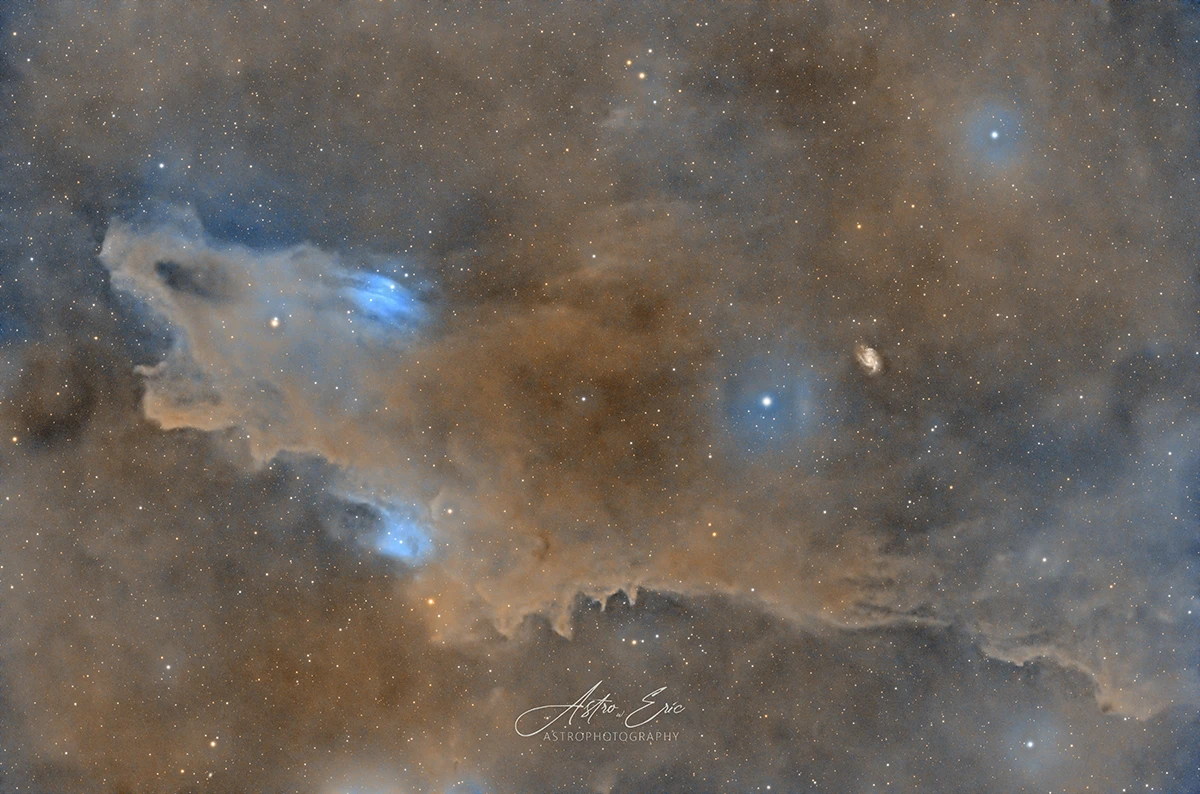
Often referred to as the Shark Nebula, LDN 1235 is a striking dark nebula located approximately 650 light-years away in the constellation Cepheus. It was cataloged by American astronomer Beverly Lynds in her 1962 Catalogue of Dark Nebulae, which she compiled using the red and blue plates from the Palomar Observatory Sky Survey. This "dark" nebula is essentially a dense, cold cloud of interstellar dust that is so thick it obscures nearly all visible light from the stars behind it. In terms of opacity, LDN 1235 is classified as an Opacity Class 5 or 6 (on a scale of 1–6), meaning it is among the most light-blocking regions in the sky. While it appears as a void in traditional broadband images, it is actually a site of high-latitude galactic cirrus, reflecting a faint, ghostly blue light from nearby stars—a phenomenon known as an Extended Red Emission (ERE).
🔭 Equipment: Optolong LRGB Filter Kit 2″, iOptron CEM60 Center Balanced Equatorial Mount, iOptron Permanent Pier, MeLE Fanless Mini PC Quieter3C, Pegasus Astro Pocket Powerbox Advanced G2, Primalucelab Alto-1 Telescope Motor Cover, Primalucelab Giotto 120 Smart Flat Field Generator, William Optics FLAT 6AIII (0.8x Reducer), William Optics Fluorostar 91, William Optics GuideStar 61, ZWO ASI2600MM Pro Monochrome Cooled Astronomy Camera, ZWO EFW (Electronic Filter Wheel) 7 x 2″, ZWO EAF Electronic Focusing Motor, ZWO f/5 30mm Mini Guide Scope, ZWO OAG-L Off-Axis Guider
📅 Session: August 13, 14, 26, 27, 30, 31, 2024
Sept 1-2, 2024
📸 Exposure: Luminance: 120 x 300s
Red: 180 x 120s
Green: 180 x 120s
Blue: 180x 120s
Total Integration Time: 28 hours
💻 Software: Nighttime Imaging ‘N’ Astronomy, PHD2 Guiding, Pixinsight