
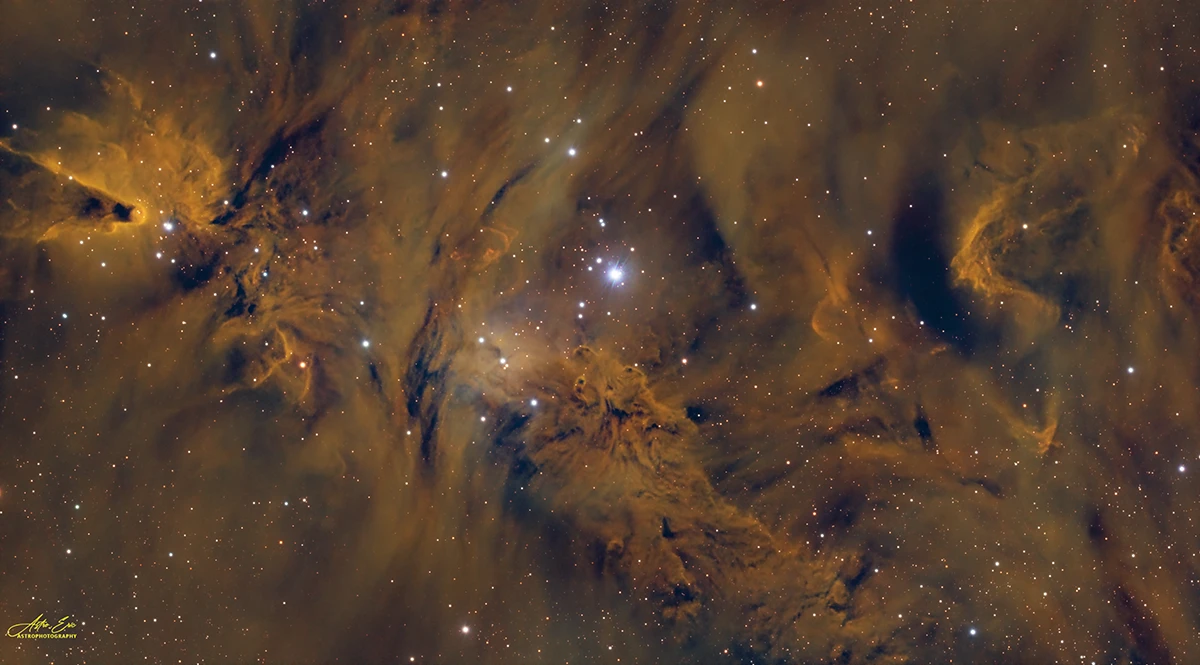
✨ Constellation: Monoceros
🚀 Distance: 2,300 to 2,700 Light Years
🔭 Equipment: Altair Astro Hypercam 585M Mono TEC Cooled USB3 Astronomy Camera, Antlia Edge 4.5nm Narrowband Hydrogen-Alpha Filter 1.25″, Antlia Edge 4.5nm Narrowband Oxygen III Filter 1.25″, Antlia Edge 4.5nm Narrowband Sulfur II Filter 1.25″, Antlia LRGB-V Pro series filters – 1.25”, iOptron CEM60 Center Balanced Equatorial Mount, iOptron Permanent Pier, MeLE Fanless Mini PC Quieter3C, Pegasus Astro USB Control Hub, Primalucelab Alto-1 Telescope Motor Cover, Primalucelab Giotto 120 Smart Flat Field Generator, William Optics Flat 68III Field Flattener, William Optics Fluorostar 91, ZWO ASI224MC One-Shot Color USB3 Planetary/Guiding Camera, ZWO CAA Camera Angle Adjuster, ZWO EAF Electronic Focusing Motor, ZWO EFW (Electronic Filter Wheel) 8 x 1.25″, ZWO f/5 30mm Mini Guide Scope
📅 Session: December 30-31, 2025 (Ha & SII) January 1-3, 2026 (Ha) January 19-21, 2026 (RGB & OIII)
📸 Exposure: Red: 60 x 60s (Gain 190, Offset 600) Blue: 60 x 60s (Gain 190, Offset 600) Green: 60 x 60s (Gain 190, Offset 600) Sulfur II (S2): 52 x 600s (Gain 200, Offset 600) Hydrogen Alpha (Ha): 50 x 600s (Gain 200, Offset 600) Oxygen 3 (OIII): 44 x 600s (Gain 200, Offset 600) Calibration Frames: 30 Flat Frames per filter, 30 Dark Flats @ 2.5s, 30 Dark Frames based on exposure length (60s & 600s) Total Integration Time: 27.3 hours
💻 Software: Nighttime Imaging ‘N’ Astronomy, PHD2 Guiding, Pixinsight
1. Pre-Processing & Calibration
Calibration and integration were performed in PixInsight using the Weighted Batch PreProcessing (WBPP) script. Post-integration, the masters were cropped using DynamicCrop and plate-solved via the ImageSolver script. To prepare the narrowband data, the SH masters were aligned to the OIII master using LinearFit.
2. Linear Phase (Narrowband & RGB)
Correction: All master frames underwent an initial pass of BlurXTerminator in “Correct Only” mode to tighten stellar profiles.
Color & Gradient: RGB stars were combined and calibrated using Spectrophotometric Color Calibration (SPCC). Monochrome narrowband masters were individually processed with Spectrophotometric Flux Calibration (SFC) followed by Multiscale Gradient Correction (MGC).
Deconvolution: A second run of BlurXTerminator was applied to the RGB image with Stellar Sharpening (0.40) and Halo Adjustment (-0.10).
Noise Reduction: Initial denoising was performed on the linear images using NoiseXTerminator (Denoise: 0.50, Detail: 0.30).
Star Removal: Stars were extracted from both the RGB and narrowband masters using StarXTerminator (Large Overlap).
3. Non-Linear Processing & Stretching
RGB Stars: The “Stars Only” image was stretched using Seti Astro’s Star Stretch (Stretch: 6.25, Boost: 1.90, SCNR Green).
Narrowband Nebula: Monochrome masters were stretched using Multiscale Adaptive Stretch (MAS), prioritizing contrast recovery (Scale: 16) and background neutralization.
SHO Composition (ImageBlend):
Ha (Base): Tinted gold/orange and adjusted for midtone detail.
OIII (Screen): Tinted blue and blended to enhance structural contrast.
SII (Screen): Tinted red and blended with black-point adjustments to prevent the red channel from overpowering the background.
4. Finishing & Enhancement
Detail Enhancement: A High Pass filter was applied via ImageBlend using the Ha master as a luminance-like mask to sharpen nebula structures. Opacity was refined to ensure a natural, “non-crunchy” appearance.
Star Recombination: RGB stars were added back to the SHO composite using the Screen blend mode.
Final Polish: A final pass of NoiseXTerminator was applied for smoothing. The process was completed by adding a custom watermark and signature via Seti Astro’s AstroMark and Insert Adder scripts.